> ## Documentation Index
> Fetch the complete documentation index at: https://docs.context.dev/llms.txt
> Use this file to discover all available pages before exploring further.
# Google Sheets
> Drop company logos into Google Sheets cells with Logo Link and the built-in IMAGE() formula. No code, no scripts.
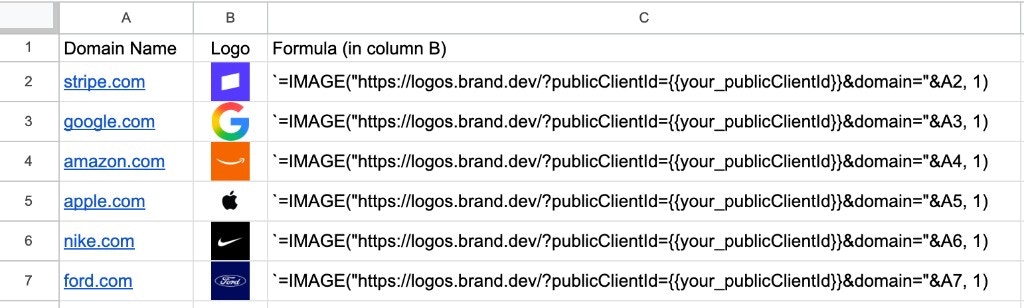
Logo Link URLs return image bytes directly. Pair them with Google Sheets' built-in [`IMAGE()`](https://support.google.com/docs/answer/3093333) formula and any cell becomes a logo.
 ## Prerequisites
* A Context.dev account with a Logo Link `publicClientId` (prefix `brandLL_`). Copy it from the [Logo Link dashboard](https://context.dev/dashboard/logolink).
## Basic usage
Use the built-in `IMAGE()` function with a Logo Link URL:
```
=IMAGE("https://logos.context.dev/?publicClientId=brandLL_xxx&domain=stripe.com")
```
## Dynamic domains
Reference a cell containing the domain instead of hardcoding it. If cell `A2` holds `stripe.com`:
```
=IMAGE("https://logos.context.dev/?publicClientId=brandLL_xxx&domain=" & A2)
```
Drag the formula down a column to fetch logos for an entire list of domains.
## Sizing
The second argument of `IMAGE()` controls how the logo fits inside the cell. From [Google's `IMAGE()` reference](https://support.google.com/docs/answer/3093333):
| Mode | Value | Behavior |
| --------------------- | ----- | ------------------------------------------------------------------------- |
| Fit to cell (default) | `1` | Resizes the image to fit inside the cell, maintaining aspect ratio |
| Stretch | `2` | Stretches or compresses the image to fill the cell, ignoring aspect ratio |
| Original size | `3` | Leaves the image at original size; may cause cropping |
| Custom size | `4` | Specify custom height and width in pixels as additional parameters |
```
=IMAGE("https://logos.context.dev/?publicClientId=brandLL_xxx&domain=stripe.com", 2)
```
For mode `4`:
```
=IMAGE("https://logos.context.dev/?publicClientId=brandLL_xxx&domain=stripe.com", 4, 120, 200)
```
Adjust row height and column width so logos display at a reasonable size. Mode `1` (fit to cell) usually looks best. Icons and monograms are square; wordmarks may be wider.
## Fallbacks
If a logo isn't published for a domain, Logo Link automatically returns a generated **monogram** based on the domain name. Note that the monogram is an SVG, which Sheets' `IMAGE()` can't render (see [Limitations](#limitations)), so for unknown domains the cell may stay blank rather than show the fallback.
## Limitations
* **No SVG.** Google Sheets' `IMAGE()` does not render SVG files. Most Logo Link responses for known brands are PNG, but the monogram fallback is SVG and won't render, so pass a known domain when you can.
* **No Google Drive URLs.** `IMAGE()` cannot load images from `drive.google.com`. Logo Link's `logos.context.dev` host is fine.
* **No volatile functions inside the URL.** `IMAGE()` rejects `NOW()`, `RAND()`, and other volatile functions in the base URL.
## Next steps
Same workflow in Excel for Microsoft 365 and Excel for the web.
All Logo Link URL options and the publicClientId setup.
Programmatic enrichment for Google Sheets rows beyond logos.
Grab your publicClientId and lock it to your own domain.
## Prerequisites
* A Context.dev account with a Logo Link `publicClientId` (prefix `brandLL_`). Copy it from the [Logo Link dashboard](https://context.dev/dashboard/logolink).
## Basic usage
Use the built-in `IMAGE()` function with a Logo Link URL:
```
=IMAGE("https://logos.context.dev/?publicClientId=brandLL_xxx&domain=stripe.com")
```
## Dynamic domains
Reference a cell containing the domain instead of hardcoding it. If cell `A2` holds `stripe.com`:
```
=IMAGE("https://logos.context.dev/?publicClientId=brandLL_xxx&domain=" & A2)
```
Drag the formula down a column to fetch logos for an entire list of domains.
## Sizing
The second argument of `IMAGE()` controls how the logo fits inside the cell. From [Google's `IMAGE()` reference](https://support.google.com/docs/answer/3093333):
| Mode | Value | Behavior |
| --------------------- | ----- | ------------------------------------------------------------------------- |
| Fit to cell (default) | `1` | Resizes the image to fit inside the cell, maintaining aspect ratio |
| Stretch | `2` | Stretches or compresses the image to fill the cell, ignoring aspect ratio |
| Original size | `3` | Leaves the image at original size; may cause cropping |
| Custom size | `4` | Specify custom height and width in pixels as additional parameters |
```
=IMAGE("https://logos.context.dev/?publicClientId=brandLL_xxx&domain=stripe.com", 2)
```
For mode `4`:
```
=IMAGE("https://logos.context.dev/?publicClientId=brandLL_xxx&domain=stripe.com", 4, 120, 200)
```
Adjust row height and column width so logos display at a reasonable size. Mode `1` (fit to cell) usually looks best. Icons and monograms are square; wordmarks may be wider.
## Fallbacks
If a logo isn't published for a domain, Logo Link automatically returns a generated **monogram** based on the domain name. Note that the monogram is an SVG, which Sheets' `IMAGE()` can't render (see [Limitations](#limitations)), so for unknown domains the cell may stay blank rather than show the fallback.
## Limitations
* **No SVG.** Google Sheets' `IMAGE()` does not render SVG files. Most Logo Link responses for known brands are PNG, but the monogram fallback is SVG and won't render, so pass a known domain when you can.
* **No Google Drive URLs.** `IMAGE()` cannot load images from `drive.google.com`. Logo Link's `logos.context.dev` host is fine.
* **No volatile functions inside the URL.** `IMAGE()` rejects `NOW()`, `RAND()`, and other volatile functions in the base URL.
## Next steps
Same workflow in Excel for Microsoft 365 and Excel for the web.
All Logo Link URL options and the publicClientId setup.
Programmatic enrichment for Google Sheets rows beyond logos.
Grab your publicClientId and lock it to your own domain.